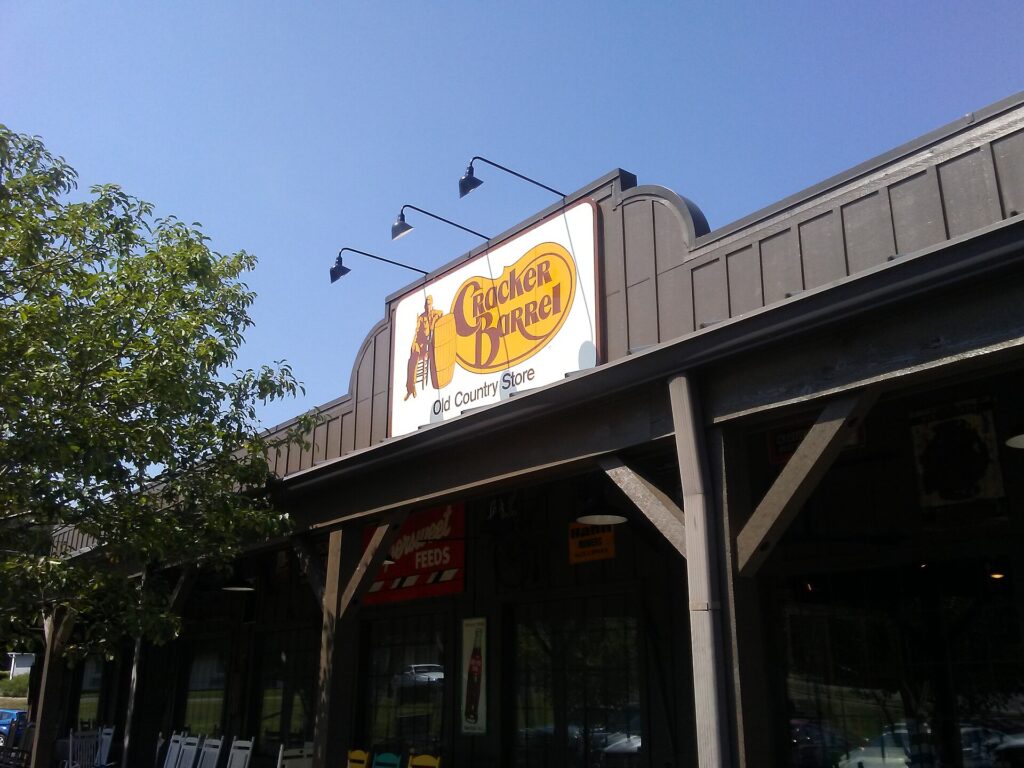
Photo: Cracker Barrel, Cleveland, Tennessee. JJBers, CC BY 2.0, via Wikimedia Commons.
Cracker Barrel tried to retire the Old Timer. Customers said no. On August 26, 2025, the chain put the familiar seated figure back in its logo, and fiscal 2026 sales came in lower. The company’s own numbers show the drop. They don’t show how much of it came from the logo fight alone.
What Cracker Barrel Changed and Restored
The Tennessee-based restaurant and retail chain had been pursuing a wider transformation of its brand and stores. That strategy included menu work, changes to restaurant interiors, and efforts to attract new customers without losing its traditional audience.
The updated logo stripped out the image commonly called the Old Timer, leaving a simpler wordmark. For a chain identified with rocking chairs, country-store merchandise and a nostalgic dining experience, the logo carried unusual emotional weight.
Some customers argued that the redesign discarded the brand’s distinctive heritage. Others regarded it as an ordinary attempt to modernize signage and digital branding. The criticism traveled widely across social media and news coverage.
Cracker Barrel reversed course on August 26, 2025. Its public statement said the replacement logo would go away and the Old Timer would remain. A company communication the following month also described pausing restaurant remodels and refocusing on food and the guest experience.
That is an important difference from a purely symbolic announcement. Management not only restored the graphic but also reconsidered parts of the broader customer-facing renovation strategy.
Customers had sent a clear signal about a particular brand element. Whether the redesign was the dominant reason for later sales weakness requires a different set of evidence.
What the Fiscal 2026 Numbers Show
In its September 2026 earnings announcement, Cracker Barrel reported fiscal 2026 revenue of $3.319 billion, compared with $3.484 billion in fiscal 2025. The difference was approximately $165 million, or about 4.7%.
The same release showed annual adjusted earnings before interest, taxes, depreciation and amortization falling to about $147.7 million from $224.3 million. Those are company-reported non-GAAP figures and should be considered alongside its standard accounting results.
Revenue is not profit, and the $165 million decrease is not an audited accounting category labeled logo costs or backlash losses. It includes the effects of restaurant and retail performance, the company’s operating decisions, pricing and changes in its business portfolio.
Results during the year also varied. For the first fiscal quarter ending October 31, 2025, Cracker Barrel said total revenue fell 5.7% from the comparable prior-year quarter. Comparable restaurant sales declined 4.7%, while comparable retail sales fell 8.5%.
The second quarter ending January 30, 2026, was weaker in some measures: the company reported comparable restaurant sales down 7.1% and comparable retail sales down 9.2% year over year.
By the fourth quarter ending July 31, 2026, comparable restaurant sales were down 2.1%, but comparable retail sales rose 0.7%. That change shows why a single early-quarter headline cannot stand in for the entire period.
The annual results are substantial and real. The uncertainty lies in assigning the decline among different causes.
What the Company Said About the Weakness
Cracker Barrel’s regulatory filings and earnings materials discuss consumer pressure, operational performance, traffic trends, menu and remodeling choices, and the risks of negative publicity. Its fiscal 2026 annual report said the decline in guest traffic was “primarily the result of negative publicity and customer reactions to certain changes in brand initiatives, including the launch of a new logo and modern test store remodels,” along with lower consumer demand from macroeconomic factors. The business was already contending with difficult economics for many casual-dining customers.
The company also faced labor, food and operating costs. Menu prices can lift reported restaurant sales per customer while lower guest visits move them in the opposite direction. Retail stores attached to restaurants have their own merchandising and inventory patterns.
Another complication is that the fiscal 2026 results include changes in the company’s portfolio. Cracker Barrel sold its Maple Street Biscuit Company business in July 2026, affecting what was included in its consolidated numbers near year-end.
The earnings release also described debt reduction through transactions and shifts in capital allocation. These strategic measures influence the company’s financial position but are not a direct count of customers offended by the logo.
Cracker Barrel’s September 2025 communications made the brand-response point explicit: management acknowledged guests had raised concerns and said it would focus on familiar elements of the experience. That is strong evidence that the company believed the backlash needed attention.
It is not the same as a controlled study quantifying how many customers would have visited if the logo had never changed.
Tradition vs. Modernization in the Logo Fight
For critics, the episode illustrated a straightforward commercial rule: a company built on tradition risks alienating its most loyal customers when it removes recognizable symbols without clearly explaining the benefit. Brand identity can be an asset that cannot be replaced overnight.
Supporters of modernization argue that restaurants must update menus, operations and interiors to remain competitive. A chain that never changes may lose younger customers or fail to address problems with service and dining quality.
Both ideas can be true. Companies need to invest, but they also need to know which features their customers regard as essential. A familiar sign can matter more in the restaurant category than a marketer expects.
The strongest conclusion here is narrower than many online claims: the redesigned logo produced visible opposition, the company reversed it, and sales were down during the subsequent fiscal year. The public financial disclosures do not isolate a dollar figure for lost logo-related business.
That distinction matters to investors evaluating management competence. One branding mistake can be a warning sign, while ongoing restaurant traffic and operating performance still demand separate scrutiny.
What the Latest Guidance Suggests
In its September 2026 full-year release, Cracker Barrel projected fiscal 2027 revenue of about $3.325 billion to $3.4 billion, together with improved comparable restaurant sales. A forecast describes management’s expectations, not money already earned.
The company also reported that it ended fiscal 2026 with total debt of approximately $337.2 million compared with $484.6 million the previous year. That balance-sheet change is important context for any claim that a brand dispute alone determined the company’s financial health.
There are therefore several separate questions for shoppers and shareholders. Has the chain kept the traditions customers value? Has food and service improved? Is restaurant traffic recovering? Do margins and cash flow support the company’s strategy?
Cracker Barrel’s response shows management can reverse an unpopular public decision. Restoring a logo is relatively fast; rebuilding routine customer visits and operating efficiency takes longer.
The Old Timer Stays. Now Comes the Hard Part.
Customers wanted the Old Timer, and they got him back. The fiscal 2026 sales drop is real and measurable. What the record doesn’t support is calling every lost dollar a backlash cost. Diners can watch whether food, service and traffic come back, and spend accordingly.
Did the logo change cost Cracker Barrel your visit, or did bringing back the Old Timer win you back? Tell us in the comments, and check the Boycott List for brands graded D or F on our woke scorecard.
Sources
- Cracker Barrel, Fiscal 2026 Fourth-Quarter and Full-Year Results, September 2026
- Cracker Barrel, Fiscal 2026 First-Quarter Results, December 2025
- Cracker Barrel, Fiscal 2026 Second-Quarter Results, March 2026
- Cracker Barrel, Fiscal 2025 Results and Management Remarks
- Cracker Barrel, Fiscal 2026 Annual Report Form 10-K
- CNBC, Cracker Barrel Scraps New Logo After Outrage From Customers, Trump, August 26, 2025