
Photo: Coolcaesar / Wikimedia Commons (CC BY-SA 4.0)
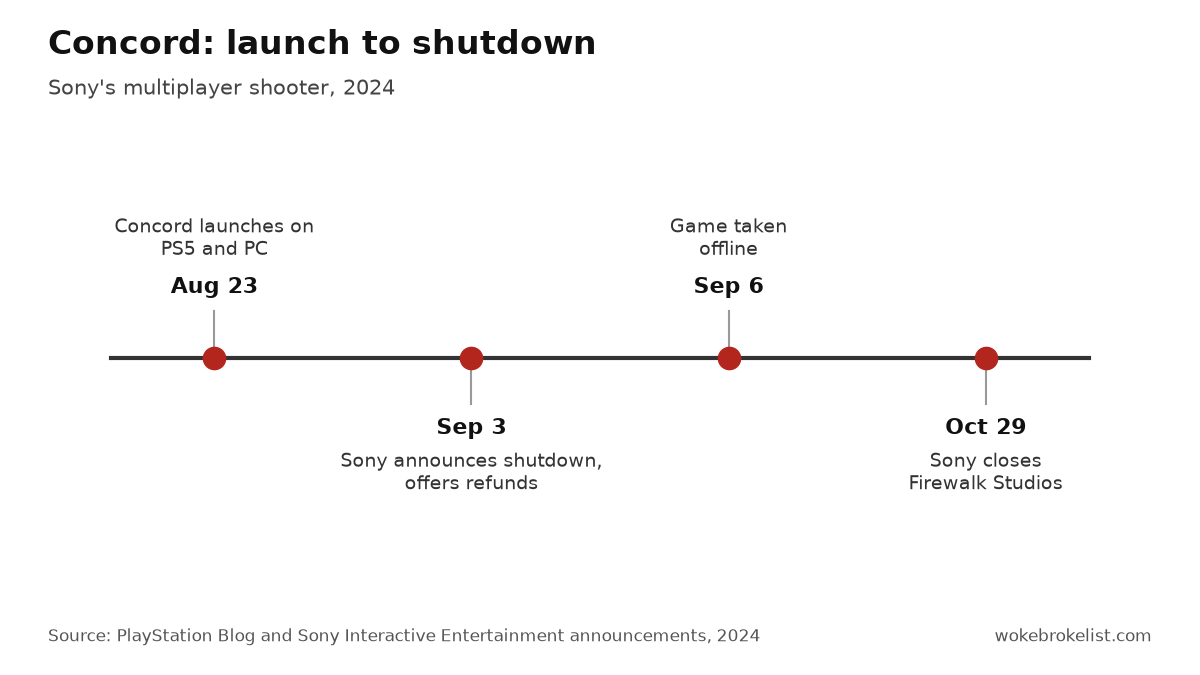
Sony launched its multiplayer shooter Concord on August 23, 2024, for PlayStation 5 and PC. By September 6, it was offline. Sony offered refunds and later closed the developer, Firewalk Studios. Sony admitted the game didn’t draw enough players, but the popular claims about its exact budget and political causes remain unverified.
From Launch to Refunds
Sony promoted Concord as a team-based shooter in which players selected characters known as Freegunners for competitive matches. The PlayStation Blog announced its August 23, 2024, launch and described different multiplayer modes and features.
It was entering a crowded market of online shooters where established competitors had years to build players’ friend networks, seasonal content and recognition. A new multiplayer game must persuade people both to try it and to remain after the first few sessions.
On September 3, 2024, just eleven days after launch, PlayStation announced that Concord would be taken offline on September 6. It began offering refunds to customers who had bought the title through its supported storefront and retail channels.
That was a material commercial decision. Refunds converted existing purchases into obligations to return customer payments, while taking servers offline removed the ability for buyers to keep playing normally.
The launch-to-shutdown interval was fourteen days. The announcement of the impending shutdown came even sooner. Those dates, not a speculative budget estimate, are the most solid starting points for measuring how abruptly the product failed.
What Sony Acknowledged
In its September 3 announcement, Sony said that some aspects of the game had resonated but that others had not landed as intended. The company said it would explore options for the title while taking the current version offline.
On October 29, 2024, Sony Interactive Entertainment announced that it would close Firewalk Studios. Sony’s leadership explained that the company had assessed its projects and that aspects of Concord had failed to appeal to enough players.
That later action rules out the assumption that the title simply paused for a quick relaunch under the existing studio. Sony instead ended the operation responsible for developing the game.
These are company statements about performance and strategy, not proof of any single marketing or ideological explanation. Sony did not, in those announcements, attribute the shutdown to objections over character diversity or a political campaign.
Sony also closed the mobile-development studio Neon Koi in the same October announcement, an action associated with a separate project. The company presented the decisions as part of a broader review of its games business.
The Budget Claims and Missing Data
Stories about Concord frequently attach very large development-cost estimates to the game’s failure. Some figures circulated through anonymous accounts and online discussion. Without a verifiable company filing or another primary financial record allocating the exact amount to this project, those estimates should not be stated as established fact.
Costs can also be defined differently: total development spending, marketing, corporate overhead, acquisition costs, post-launch support and accounting impairments are not interchangeable.
Sony did not publicly break out a complete project-level income statement showing Concord revenue, lifetime spending, refunds and net loss. Consequently, the best-supported conclusion is that the shutdown and refunds represented a business failure whose precise financial cost was not disclosed.
It is possible to say that Sony faced a loss of development and launch investment without manufacturing a specific number. It is also possible to discuss a short active lifespan without asserting an independently unverified player count.
An annual or quarterly game-segment profit figure would not answer the project question either. A company can earn money from its larger PlayStation business while taking losses on an individual title.
Price, Style or Politics: Why Concord Missed
The game was a new $39.99 entrant in a field where many multiplayer competitors were free to begin playing. Players were being asked to buy access to an unproven title when they could already join active communities elsewhere.
Competition is only part of the explanation. Player impressions of character design, controls, maps, personality, marketing and the amount of available content can all influence retention. The official announcements did not isolate which factor accounted for most of the shortfall.
Some critics argued that the game’s visual style and character presentation reflected corporate cultural priorities instead of audience demand. Others saw ordinary product-market problems: weak differentiation, an unfavorable price comparison and insufficient awareness of why the game was worth switching to.
Those are competing assessments rather than established accounting conclusions. A game’s inclusive roster and its poor commercial result can coexist without the former proving the latter.
Sony’s own explanation emphasized the game’s failure to connect with enough players. That account is less dramatic than a claim of a single-cause political backlash, but it aligns with the decisions Sony publicly announced.
What the Shutdown Reveals About Gaming
Online games rely on active communities. A weak launch can trigger a difficult cycle: players worry that the game will not survive, making them less likely to buy it, which further reduces the community available to others.
This differs from a single-player release. A smaller number of buyers can still enjoy an offline title years after launch, while a server-dependent product may lose core functionality if the publisher withdraws support.
The refunds and closure also raise questions about consumer rights in online entertainment. Buyers may assume that purchasing a game creates durable access, but service terms and infrastructure make that expectation uncertain for live-service titles.
Sony’s experience illustrates the risk of funding large new multiplayer projects in a competitive market. The right lessons concern product differentiation, player demand, pricing and the responsibilities owed to purchasers—not unsupported certainty about an undisclosed loss figure.
Two Weeks, Then Lights Out
Sony confirmed the launch, shutdown, refunds and studio closure, which makes Concord a clear failed rollout. Its true cost and any single cultural cause aren’t in the public record. Gamers can weigh that when deciding which publishers earn their money.
Was it the price, the style or something else that kept you from buying Concord? Make your case in the comments, then see which brands landed on our Boycott List.
Sources
- PlayStation Blog, Concord Launches on PS5 and PC, August 23, 2024
- PlayStation Blog, An Important Update on Concord, September 3, 2024
- Sony Interactive Entertainment, An Update from PlayStation Studios, October 29, 2024
- PlayStation Blog, Concord Gameplay Revealed, May 30, 2024
- PlayStation Blog, Concord Is Now Available to Pre-Order, June 6, 2024