
Photo: Tdorante10 / Wikimedia Commons (CC BY-SA 4.0)
General information only, not financial or legal advice. Checked October 2026.
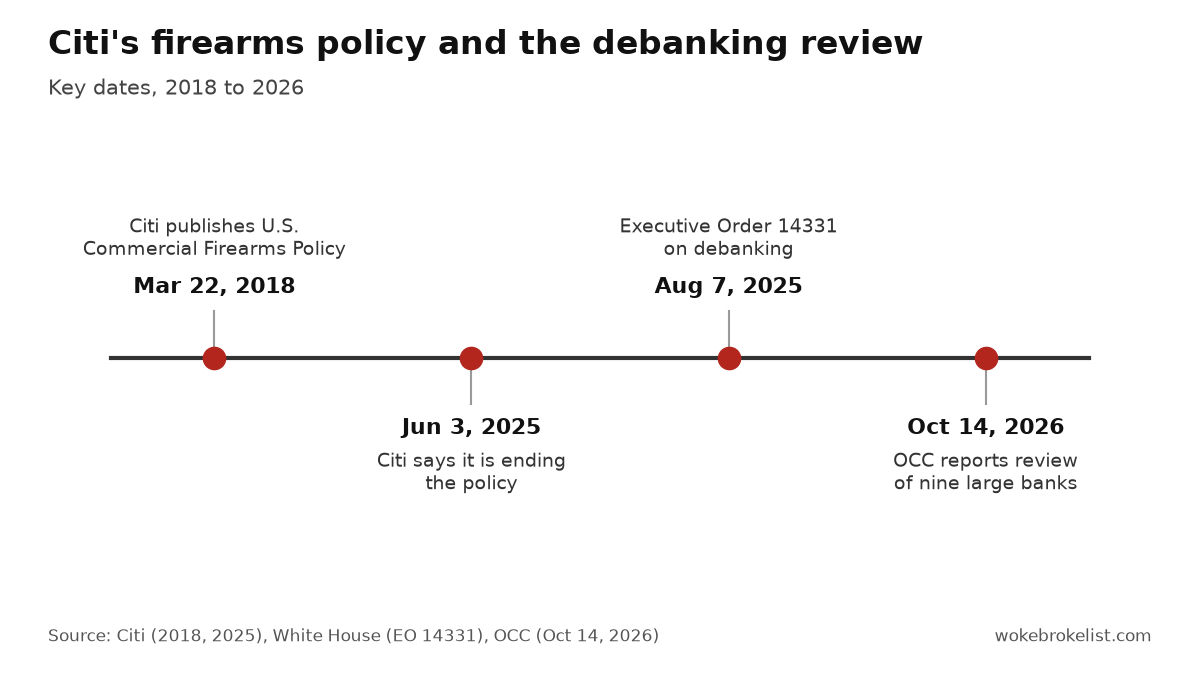
In March 2018, Citigroup put new conditions on some U.S. retail customers and partners that sell firearms. On June 3, 2025, it said it was ending that Commercial Firearms Policy. A later federal banking review found sector-specific policies were a wider issue at the biggest banks.
What Citi Required in 2018
On March 22, 2018, Citi published its new U.S. Commercial Firearms Policy. The company said certain new retail-sector clients and partners would need to follow its listed sales practices.
Those practices included refusing firearm sales without background checks, restricting sales to buyers under 21, and declining to sell bump stocks or high-capacity magazines. The policy went beyond some legal requirements depending on the type of transaction and jurisdiction.
Citi presented the conditions as risk management and a response to gun violence. Critics regarded them as a large financial institution making policy for lawful retailers instead of leaving those decisions to legislatures and customers.
It is important to identify whom the policy addressed. In its June 2025 explanation, Citi said the policy pertained to retail clients and partners and did not address firearm manufacturing. Descriptions that Citi’s 2018 policy universally prohibited all lending to every firearm manufacturer are therefore inaccurate.
The 2025 Reversal
Citi announced its policy change in a June 3, 2025, statement about fair access to financial services. It said it would no longer maintain a firearms-specific policy and would explicitly add political affiliation to its nondiscrimination commitments.
The bank said it would continue managing risks appropriately, noted that many retailers had been following the best practices, and said it hoped communities and lawmakers would keep seeking ways to prevent gun violence. That is a significant qualification. Withdrawing a sector-specific rule does not mean Citi promised to approve every merchant account or loan application involving firearms.
Ordinary underwriting, creditworthiness, fraud controls, sanctions rules and other laws remain applicable. Businesses can still be rejected for reasons unrelated to political disagreement.
The immediate commercial effect of Citi’s reversal is not publicly isolated as an earnings number. Citi did not disclose a sum representing lost firearm-industry profits from the former rule or a forecast showing how much revenue the reversal would produce.
The reliable before-and-after evidence is the written company policy: restrictions published in 2018 and discontinuation announced in 2025.
How the Issue Spread Beyond One Bank
Other major lenders have faced questions about their relationships with firearms producers, distributors and retailers. Some controversies concern particular weapons or business practices, rather than total rejection of the industry.
These distinctions matter because a bank may lend to a major manufacturer while declining a different borrower or product category. A statement about refusing to finance a certain weapon does not necessarily reveal policy toward every gun store, ammunition producer or merchant processor.
In October 2026, the Office of the Comptroller of the Currency reported its review of nine large banks’ practices. The OCC said it found formal and informal sector restrictions involving firearms or ammunition manufacturing and distribution, among other industries.
The OCC reviewed nearly 100,000 complaints and about 420,000 pages of materials, according to its October 14, 2026, announcement. Those figures describe the scale of the review, not the number of proven unlawful closures.
The agency argued that broad and subjective reputation-risk criteria disadvantaged lawful customers. Specific cases still require analysis to determine why a financial institution denied service.
Can a Bank Say No to a Lawful Gun Seller?
Second Amendment supporters argue that a lawful industry should not face coordinated restrictions simply because bank executives oppose its products. They worry that banks and payment processors can impose commercial conditions that elected lawmakers never enacted.
Banks counter that they must evaluate financial, regulatory and reputational exposures. They argue that private firms should retain some discretion over business relationships and that a controversial sector may pose specialized risks.
Both sides can recognize the difference between a business’s objective risk and the political preferences of the institution’s leadership. A borrower with insufficient cash flow is not entitled to a loan. A solvent lawful business denied solely because management dislikes its industry raises a different fairness question.
Customers considering a financial institution can ask whether it publishes categorical exclusions, how it handles account closures and whether it provides a meaningful appeal process.
How Government Policy Changed the Debate
Executive Order 14331, issued August 7, 2025, directed regulators to review politically motivated or unlawful debanking. The OCC, which had removed references to reputation risk from its handbooks and guidance earlier in 2025, announced further fair-access steps in September 2025.
These developments increased pressure on financial institutions to identify and document objective reasons for restricting services. They did not repeal anti-money-laundering rules or force lenders to extend unsafe credit.
The distinction protects customers on both sides. Banks retain lawful risk controls, while a company doing legal business should have a clearer path to ask why service was denied.
The same principles extend beyond firearms to energy, digital assets and other politically disputed sectors. Banking access is essential infrastructure for companies of many kinds, which is why transparent standards have importance beyond a particular cultural issue.
Know Your Bank’s Policy on Lawful Industries
Citi’s published reversal is a concrete case of a lender changing course on gun retailers. Federal findings show fair access is still under review, though they don’t prove every denial was unlawful. Compare banks’ public policies and choose where to keep your money.
Has a bank ever turned your business away over a lawful product? Tell your story in the comments, and see which companies made our Boycott List.