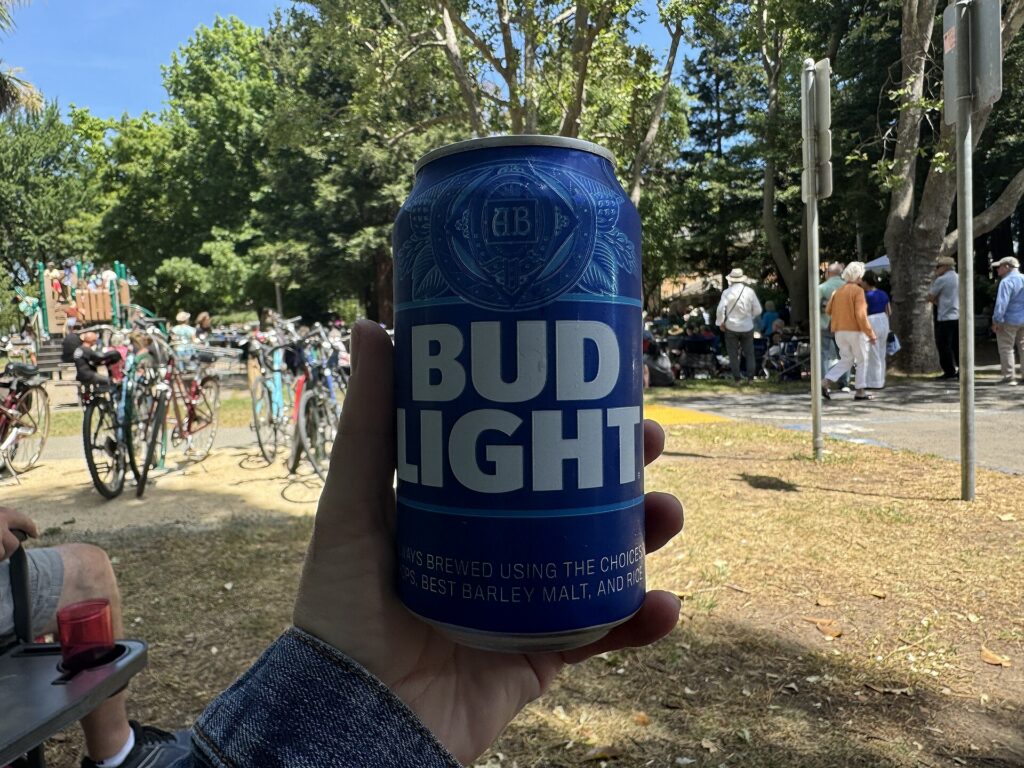
Photo: A hand holding a can of Bud Light in a park. Missvain (Sarah Stierch), CC BY 4.0, via Wikimedia Commons.
More than three years after the April 2023 Bud Light promotion, Anheuser-Busch InBev is still talking about a changed U.S. beer market. The brewer admitted real U.S. damage when the backlash hit. Its brands around the world went other ways. Here’s what the filings prove, and what they don’t.
What Happened in 2023
Bud Light faced a consumer backlash after a promotional social-media partnership with transgender influencer Dylan Mulvaney became public in April 2023. Some drinkers said they would stop purchasing the brand, and competing beers gained attention.
The immediate results were not merely a count of angry online comments. In its second-quarter 2023 results, AB InBev reported that U.S. revenue declined 10.5% and U.S. sales to retailers fell 14% year over year. Sales to wholesalers fell 15%, according to the company’s August 2023 release.
Read our full Bud Light Woke Company Report.
The company said U.S. earnings before interest, taxes, depreciation and amortization declined 28.2% in that quarter. It attributed the decline in U.S. sales to retailers primarily to the volume decline of Bud Light.
Those figures measure its U.S. business, not Bud Light alone. They are still strong company-origin evidence that the consumer reaction had meaningful commercial effects during the period.
The difference between sales to retailers and sales to wholesalers also matters. Retailer sales approximate goods moving into stores from the distribution system, while wholesaler shipments can reflect inventory adjustments. The measures need not move identically in a given quarter.
What the Following Years Showed
The company’s annual statements disclosed continued declines in U.S. sales to retailers after the initial disruption. AB InBev reported U.S. sales-to-retailers volume down 11.9% for 2023 and declines of about 5.0% in 2024 and 3.2% in 2025, based on its successive annual results.
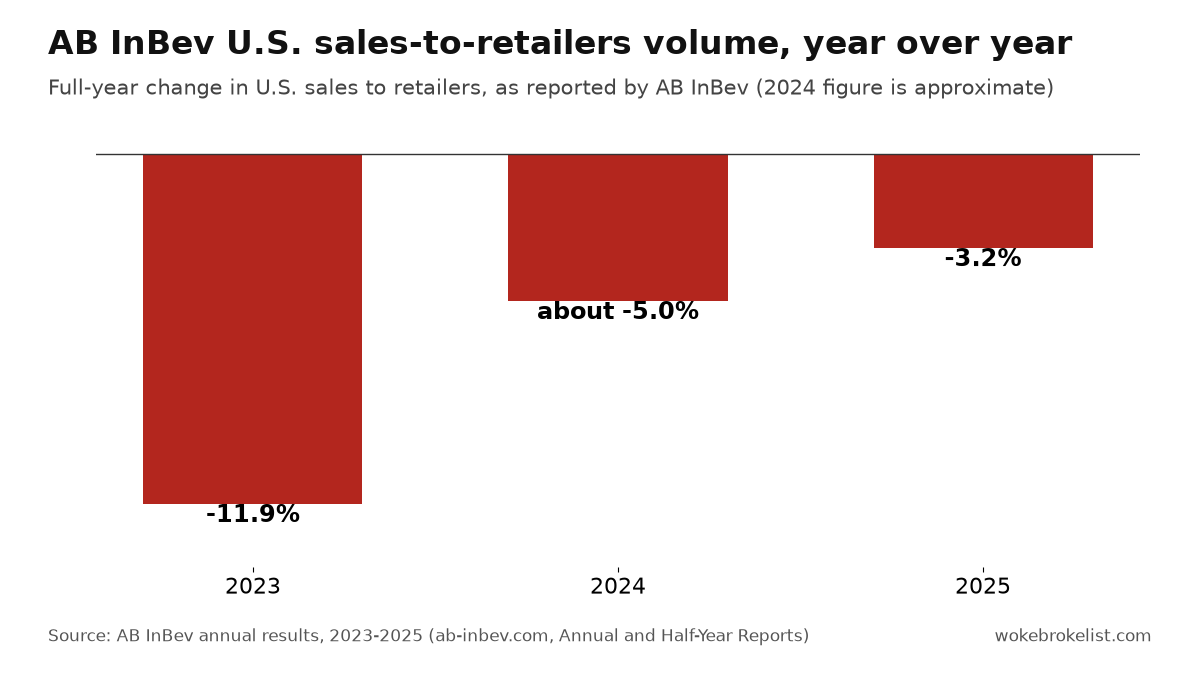
These numbers tell a more nuanced story than the claim that every U.S. beer purchase disappeared. The deepest percentage decline came during the original year; later declines were smaller but indicated that the market had not returned automatically to its prior state.
AB InBev’s 2025 full-year global results told a different story. In its February 2026 release, the company said global revenue grew organically by 2.0% for 2025, even as total company volumes fell 2.3%. Reported revenue was approximately $59.32 billion, affected by currency translation.
Those global results include many brands and markets outside the United States. They neither erase Bud Light’s losses nor show that Bud Light itself rebounded by the amount reported for the global company.
Any year-to-date figure should be compared with the same period in the previous year and not presented as a full-year outcome.
The key lesson is to specify the geography, brand, sales measure and time period before drawing conclusions.
What the Parent Company Did Differently
AB InBev responded to the controversy with changes to its U.S. marketing and distribution efforts. It emphasized supporting distributors, rebuilding confidence and communicating with core beer customers.
Its portfolio is also broader than one brand. Michelob Ultra, Busch, Budweiser and other offerings serve partly different consumers and occasions. A former Bud Light buyer who switches to another AB InBev product represents a different economic outcome from a buyer who leaves the corporate portfolio entirely.
This is why company-level earnings do not identify the exact cost of Bud Light’s individual promotion. Global growth in another product can offset weakness while Bud Light remains under pressure.
AB InBev has also developed products for consumers seeking lighter or nonalcoholic options. Its February 2026 corporate results discussed stronger performance from premium brands and nonalcoholic beer in parts of the portfolio.
The broader industry environment has shifted. Some consumers are buying less alcohol, choosing other beverages or seeking different price points. Retail prices, disposable income and changing social habits also affect sales. The 2023 controversy is part of the brand’s history but cannot automatically explain every later quarterly movement.
An accurate financial assessment therefore has two parts: acknowledge the initial measurable consumer backlash, then analyze later reported results without treating time sequence alone as proof of cause.
What the Boycott Can and Cannot Prove
Bud Light offers an unusually clear case of a political controversy coinciding with a documented near-term business decline that the company itself acknowledged. It is reasonable to say the backlash damaged U.S. performance during 2023.
It is less sound to state that all subsequent lost volume was caused only by the controversy. The beer category, competition, portfolio mix and consumer preferences changed throughout the following years.
Nor should changes in the AB InBev share price be used as a one-to-one boycott-loss estimate. Share prices reflect global earnings expectations, interest rates, currencies, debt and investor views about the whole corporation.
The widely discussed change in U.S. beer-sales rankings is another form of evidence, but it is different from reported revenue and profit. A ranking may be based on dollars, barrels or retail tracking for a particular channel. A brand can fall in one measure without declining by the same percentage in another.
For shoppers, the useful information is concrete: which products are part of the same parent company, what each brand represents and whether the company’s response meets their expectations.
Why Beer Drinkers Still Split Over the 2023 Promotion
Critics of the 2023 promotion argue that Bud Light abandoned its established customer identity while pursuing cultural messaging that many buyers did not want associated with their beer. They say the reaction showed the financial danger of using a mainstream consumer brand as a vehicle for political or social causes.
Defenders contend that companies may work with a wide range of creators and should not be punished for featuring people with different identities. They also argue that outrage campaigns can exceed the actual content or scale of a promotion.
The financial evidence does not settle the normative argument. It shows that brand choices can affect customer loyalty and that consumer responses may have consequences large enough for management to discuss in filings.
The same evidence cautions against treating the boycott as either a total destruction of the parent company or an event with no material effect. The U.S. brand and global brewing group followed different trajectories.
Three Years On, the Receipts Are Public
AB InBev’s own results show heavy U.S. damage when the backlash began and pressure that lasted. They also mix in other brands, countries and a shifting beer market, so there’s no clean three-year loss number. Bud Light drinkers already showed what a boycott looks like. Whether it continues is up to them.
For more on the brand, start with our Bud Light Woke Company Report linked above, then set it beside the other D and F companies on our Boycott List. Pass this along to anyone still arguing about 2023.