
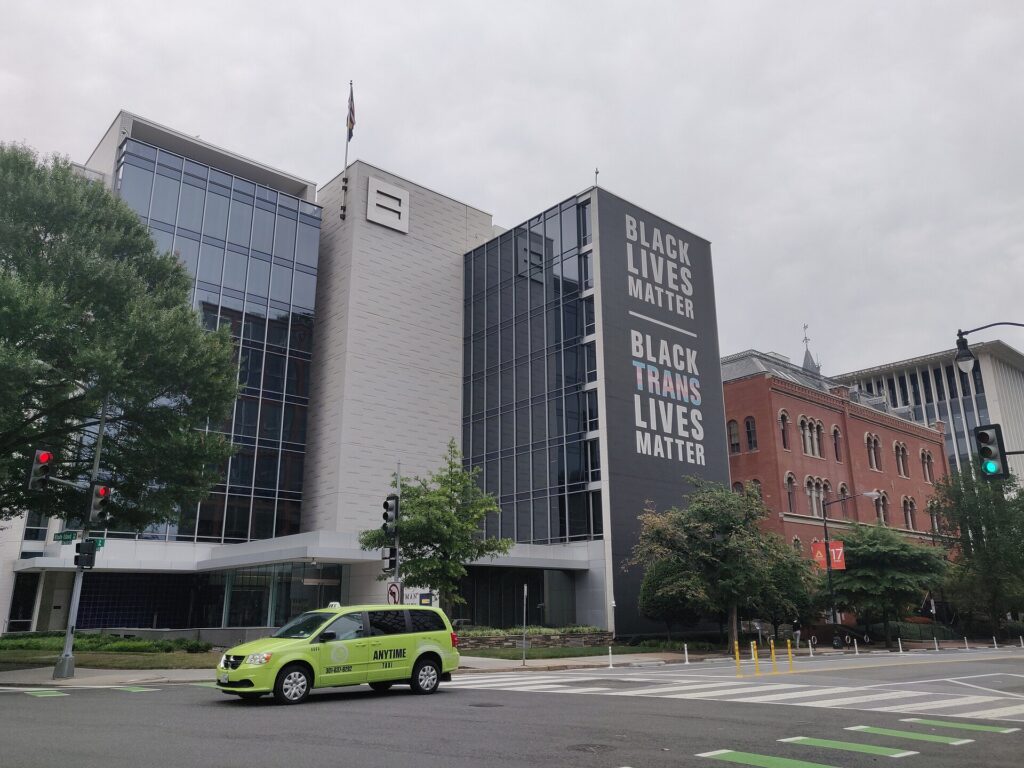
Photo: Kurt Kaiser / Wikimedia Commons (CC0)
Fortune 500 companies are walking away from the Human Rights Campaign’s scorecard. HRC’s own February 2026 release says just 131 Fortune 500 firms submitted information for its Corporate Equality Index, down from 377 in the prior index. That’s a big shift in how companies show off LGBTQ-related policies. But skipping the survey isn’t the same as dropping every policy it measures.
What the Corporate Equality Index Measures
The Corporate Equality Index, commonly called the CEI, is a benchmarking program produced by the Human Rights Campaign Foundation. It evaluates employers on stated policies and practices affecting LGBTQ employees, including nondiscrimination protections, benefits and organizational practices.
Employers can submit surveys and documentation. The foundation may also use publicly available information when it has enough evidence to assess a company that did not submit.
That second route is significant. A company cannot necessarily erase its public record by refusing to answer. Conversely, the absence of a current response does not automatically mean an employer removed health benefits, discrimination protections or employee programs.
The index is voluntary but has acquired influence as a marker of participation in a broader workplace movement. Some companies once used top scores in recruiting and communications. Critics question why an outside advocacy organization should influence routine personnel decisions.
Supporters say the index provides transparency to applicants, employees and investors. Critics argue that a score can reward politically contested policies beyond equal treatment under the law.
The Participation Drop Was Large
The HRC Foundation’s 2026 publication reported a 65% decline in Fortune 500 submissions, from 377 in the 2025 index to 131 in 2026. Its release said CEI-rated companies collectively employed more than 22 million U.S. workers.
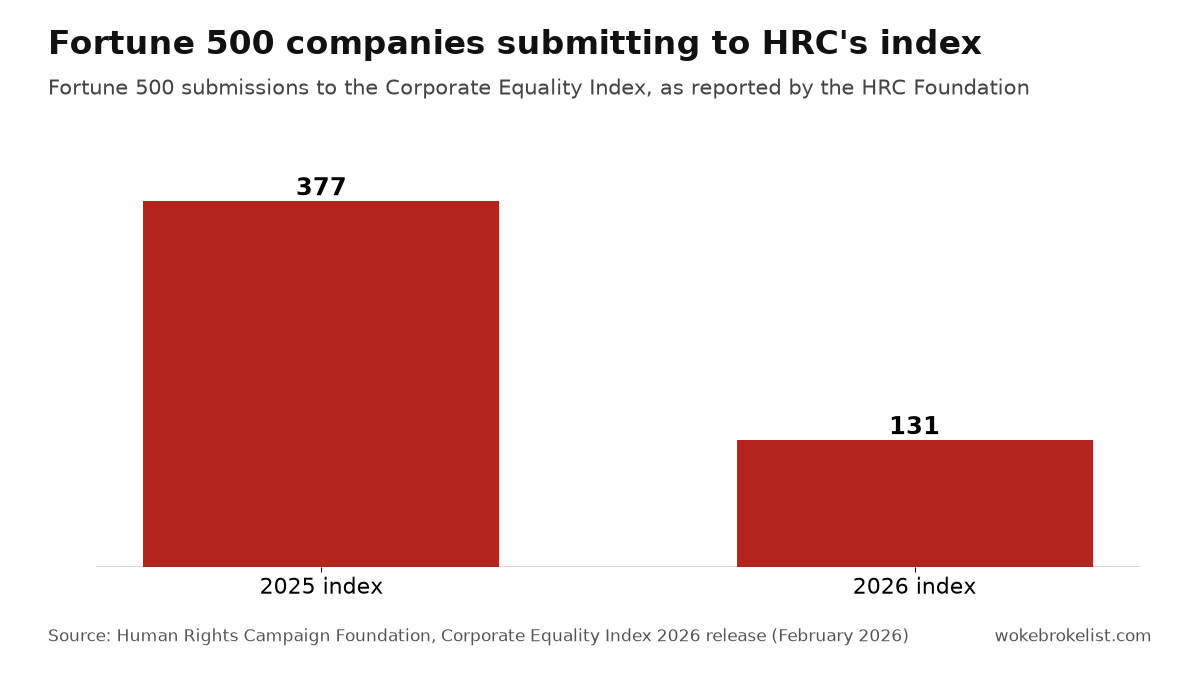
The same organization reported that 765 employers achieved its top score in the 2025 index. These numbers measure different things: top-scoring employers across the broader program are not the same as Fortune 500 companies voluntarily submitting surveys in a later year.
It would therefore be incorrect to compare 765 with 131 and claim a single percentage decline. The defensible like-for-like measure is the foundation’s stated Fortune 500 submission series.
The change occurred amid debate over DEI, shareholder campaigns, scrutiny of corporate political activity and uncertainty surrounding federal contractor expectations. Executives also faced a practical question: what business value comes from providing detailed information to an external group that can become a source of controversy?
Some companies decided the benchmarking exercise was no longer worthwhile. The fall in participation is observable even when the motives of individual firms cannot be proved.
Which Companies Explicitly Changed Course?
Tractor Supply gave a clear example. Its June 27, 2024, company statement said it would no longer submit data to the Human Rights Campaign, alongside changes to DEI roles, sponsorships and corporate goals.
Target followed with a January 2025 policy update announcing that it would stop external diversity-focused surveys, specifically including the CEI. Target also revised workforce and procurement initiatives while retaining employee development programs.
McDonald’s announced in January 2025 that it would cease external surveys during a review of its inclusion strategy. Its statement continued to affirm workplace inclusion, illustrating why ending a survey does not necessarily eliminate related workplace practices.
In contrast, some major companies publicly resisted pressure to leave. The HRC Foundation reported in March 2025 that Disney shareholders overwhelmingly rejected a proposal questioning the company’s participation. A shareholder vote on a proposal does not itself prove all shareholders endorse every part of the rating system.
Read our full Target Woke Company Report.
These examples show distinct corporate choices: explicit departure, broader withdrawal from outside surveys and continued engagement. They should not be grouped indiscriminately as companies that abandoned protections for employees.
Why the HRC Score Split Employers and Advocates
Companies once saw DEI rankings as an opportunity to demonstrate values to workers and customers. In a more polarized environment, those same rankings can signal advocacy positions that some customers reject.
Conservative critics say businesses should not let outside advocacy scores determine benefits or hiring priorities. They also question whether a high score pressures management to support causes beyond the core business.
The HRC Foundation argues that disclosure helps employees and job candidates evaluate employers, and that inclusive policies can aid recruitment and retention. Its 2026 report described the drop as fewer employers choosing “to publicly document their practices through CEI submissions.”
That qualification is important even for skeptical readers. If the claim is that one employer changed its practices, the evidence should identify a change to a handbook, benefit plan, written policy or operating procedure. A declined questionnaire establishes only nonparticipation.
No generally applicable financial figure shows that leaving the CEI increased corporate revenue. Company performance depends on pricing, competition, financing and operational decisions as well as customer sentiment. The available data do not isolate survey participation as an independent profit driver.
What Shoppers and Employees Can Check
A useful policy review starts with the current nondiscrimination statement, employee benefits description, supplier rules and political spending disclosures. Those documents may reveal material practices that a single score cannot capture.
Dates matter. A business might withdraw from the 2026 survey while existing benefits continued unchanged. It might also change its policies without any effect on an old published ranking until the following cycle.
Shoppers should distinguish an advocacy ranking from compliance with federal workplace law. A private score does not replace Title VII obligations, and companies remain responsible for lawful hiring, promotion and workplace practices whether they answer the CEI questionnaire or not.
The main documented development is retreat from voluntary participation in an influential outside rating. Evidence of a broader policy change must be assessed company by company.
The Scorecard Lost Its Grip
The drop from 377 to 131 Fortune 500 submissions is documented. What it means differs from employer to employer. Look at what each company actually changed and judge whether it fits your priorities. Trust is earned, and shoppers decide who earns theirs.
Tractor Supply wasn’t the only name to change course. Our Target Woke Company Report, linked above, covers another, and the Boycott List has every D and F grade in one place.