
Photo: Warren LeMay / Wikimedia Commons (CC0)
In January 2019, Gillette ran an ad about harmful male behavior and set off a fight over whether a razor brand should lecture its customers. Seven years later, Procter & Gamble’s filings show big changes at the brand. They don’t show a reliable dollar figure lost because of that ad.
What the Advertisement Said
The video campaign, commonly called The Best Men Can Be, adapted Gillette’s longstanding The Best a Man Can Get slogan. It addressed bullying, harassment, aggressive conduct and the role of men as positive examples.
Some viewers supported the message as a call for decency and responsibility. Others objected that a razor maker had used stereotypes about men to make a political or cultural point to its own customers.
The backlash included complaints, calls to stop buying and criticism of the company’s marketing priorities. Public reaction was visible, but social-media comments are not audited financial data. A viral post saying customers were leaving cannot prove the size of the resulting revenue effect.
Gillette’s parent competes in a market where customers choose among branded cartridges, subscription services, private-label razors and other personal-care products. Those choices existed before the campaign and continued afterward.
The advertisement’s meaning is also disputed. Critics saw collective blame of men; defenders saw encouragement to intervene against misconduct. A fair assessment describes both interpretations while keeping the sales question separate.
The Impairment That Was Widely Misread
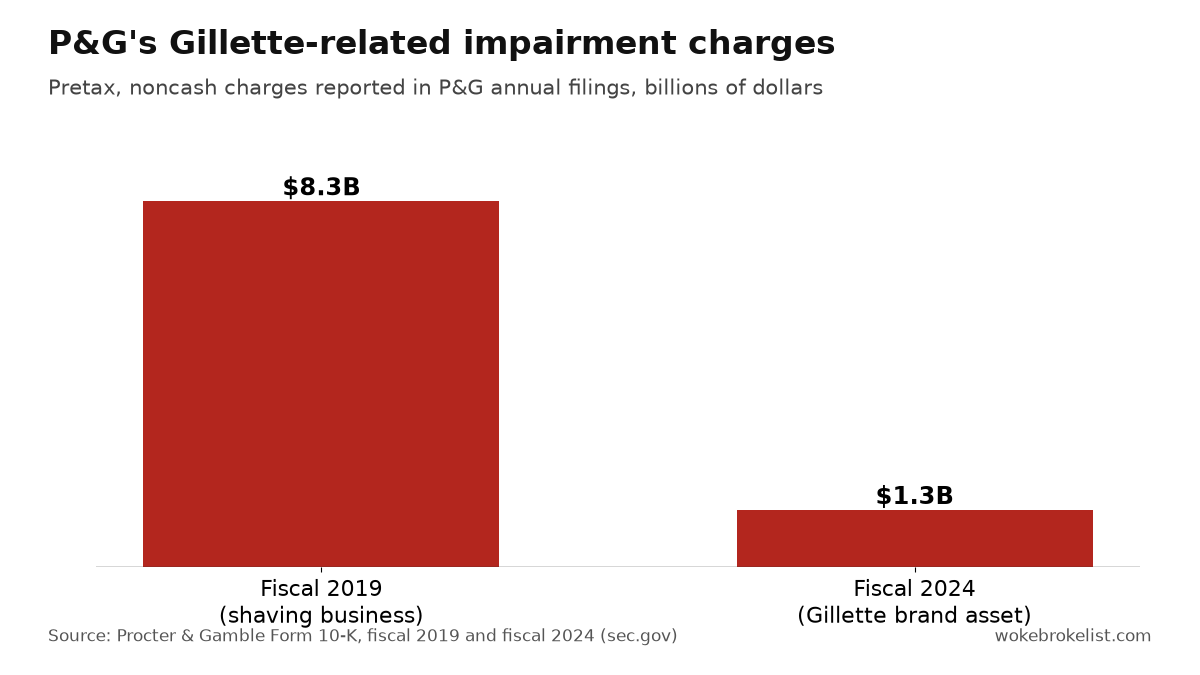
In its fiscal 2019 annual filing, Procter & Gamble reported an $8.3 billion pretax, noncash impairment related to the shaving business, equivalent to about $8.0 billion after tax. It included $6.8 billion of goodwill impairment and a $1.6 billion pretax write-down of the Gillette brand intangible asset. The company attributed the lower fair value largely to currency devaluations, slower category growth from changing grooming habits, primarily in developed markets, and increased competition in the U.S. and other markets.
Some commentary connected the charge directly to the advertisement because both occurred in 2019. That is a weak inference. An intangible-asset impairment reflects management’s estimated value of a business or brand under accounting rules. It is not an invoice for customers who walked away over an advertisement.
Procter & Gamble’s annual filing discussed sustained category challenges, pricing and foreign-exchange pressure. The filing did not attribute the impairment to the January advertisement or quantify backlash losses.
This matters for investors. A large accounting charge is a real hit to reported earnings in the period, but it is not necessarily an equal reduction in cash sales and does not identify the cause of every underlying business trend.
Separating the impairment from any backlash claim does not mean customer reaction was commercially irrelevant. It means a specific loss amount cannot be stated as fact without records supporting it.
What More Recent Filings Show
Procter & Gamble disclosed another Gillette brand impairment in fiscal 2024. Its 2024 annual report identified a $1.3 billion pretax noncash charge, equal to about $1.0 billion after tax, on the Gillette indefinite-lived intangible asset. The company discussed foreign-exchange assumptions and business conditions in the relevant financial notes.
The company’s fiscal 2026 annual report revisited that charge and reported that the Gillette intangible asset had a carrying value of about $12.8 billion on June 30, 2026. That figure shows the brand remained a major recorded asset, not that every consumer or investor supported its advertising.
The 2026 report also stated that a prior impairment analysis conducted in the quarter ending December 31, 2025, put fair value more than 10% above carrying value. This is a useful detail: the company did not simply continue reporting the same level of impairment pressure in every later period.
None of those figures establishes that the 2019 campaign caused a 2024 accounting adjustment. Five years separated the advertisement from that charge, and the company identified broader operating and currency considerations.
To estimate campaign-specific economic damage, analysts would need sales data for Gillette products versus comparable brands, controls for category trends and pricing, and a method isolating the impact of the advertising. A parent-company earnings table does not provide that experiment.
What Competitors Changed
The shaving aisle changed as younger customers tried lower-priced options, online subscriptions and reusable alternatives. Consumers also reconsidered how frequently they bought blades and what they were willing to pay for premium cartridges.
Those shifts can affect even a brand with marketing that attracts no political controversy. A company can lose share because of price competition while simultaneously drawing criticism for its message. One fact does not automatically explain the other.
Gillette has continued advertising and selling products, including promotions connected to sport, shaving performance and the familiar original tagline. Its own campaign history says that since 2019 it has “donated millions” to organizations focused on the development of young men and boys. The company said it refined that emphasis in 2022 toward positive male role models. The parent company’s later communications have emphasized shaving innovation and understanding customer needs.
For a skeptical customer, the useful comparison is between actual products, prices and disclosed business performance. For a shareholder, it includes the company’s segment reports and the specific accounting explanations in its securities filings.
Social-media views and brand surveys might provide additional context, but they should not be casually converted into lost revenue. Nor should a product’s survival in stores be treated as proof there was no backlash.
Should a Razor Brand Take a Stand?
Critics argue that consumer-product companies should focus on making reliable products instead of using advertising to judge their customers’ attitudes. They believe messages perceived as accusatory can weaken loyalty, particularly when a brand has spent decades associating itself with its target audience.
Defenders of the campaign maintain that brands can take public positions on conduct without claiming that all customers are guilty of it. They regard the message as consistent with social responsibility and expect companies to communicate values as well as product features.
Both positions involve a commercial question: does the marketing make the product more attractive to enough buyers to justify the risk of alienating others? Procter & Gamble’s publicly available records do not isolate that answer for this particular advertisement.
Consumers who object can choose a competing razor. Consumers who approve can continue buying Gillette. The market’s cumulative verdict is more complex than a single viral campaign or impairment headline.
Judge the Razor, Not Just the Ad
Gillette faced a real backlash over its 2019 message, and P&G later booked real accounting charges for the brand. The filings don’t pin those charges on one ad. Judge the message, compare the products and prices, and decide where your money goes.
The lesson from Gillette: buy the razor on its merits and treat the ad as one more data point. Our Boycott List tracks the brands graded D or F, and the comments are open.