The words “Starbucks boycott” have meant two very different things for more than a decade. For conservatives, the fight has run from holiday cups to a refugee-hiring pledge to race-based diversity targets that Florida’s attorney general took to court. For the union organizing Starbucks baristas, it is about a first contract that still does not exist five years after the first store voted to unionize.
The two campaigns share a target and a hashtag, and little else. On Sept. 17, 2026, the conservative thread reached a legal milestone: Starbucks settled Florida’s civil rights lawsuit over its diversity policies, agreeing to pay $1 million and to comply with the Florida Civil Rights Act while admitting no wrongdoing. Three weeks earlier, on Aug. 25, the union thread escalated when Starbucks Workers United called for an open-ended consumer boycott.
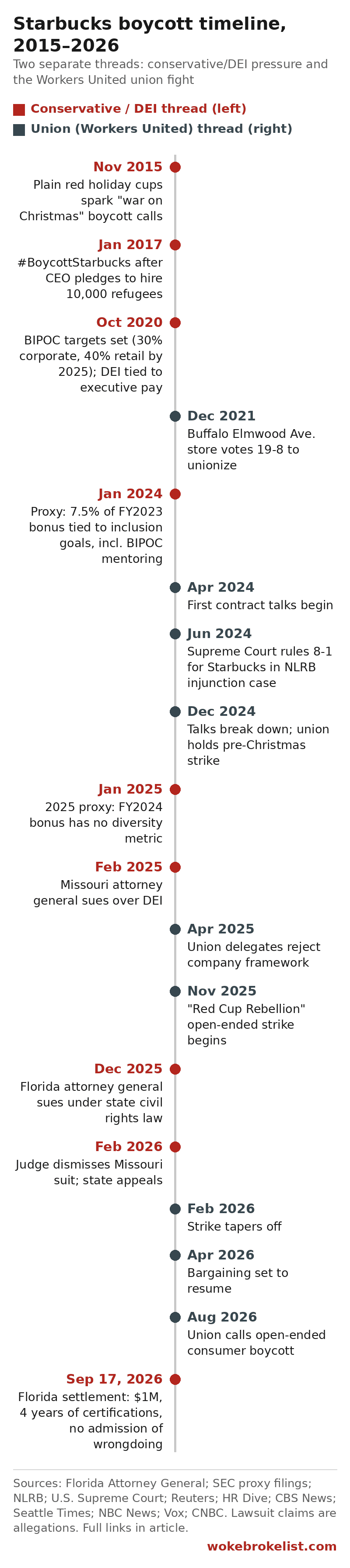
Below is a dated timeline of both, kept apart on purpose, because the two boycotts want very different things from the company.
Two Starbucks Boycotts, Two Different Complaints
Swipe to see more →
| Thread | Who is pressing it | Core complaint | Status, November 2026 |
|---|---|---|---|
| Conservative / DEI | Conservative customers and commentators; Republican attorneys general in Missouri and Florida (in court, not as boycotters) | Holiday cups (2015), a refugee-hiring pledge (2017), race-based targets (2020) and diversity-linked bonuses (fiscal 2021 to 2023) | Florida suit settled Sept. 17, 2026, with no admission of wrongdoing; Missouri suit dismissed and on appeal |
| Union | Starbucks Workers United and allied labor groups | No first contract; the union also alleges unfair labor practices | Open-ended consumer boycott called Aug. 25, 2026; no contract |
The Conservative Starbucks Boycott, 2015 to 2026
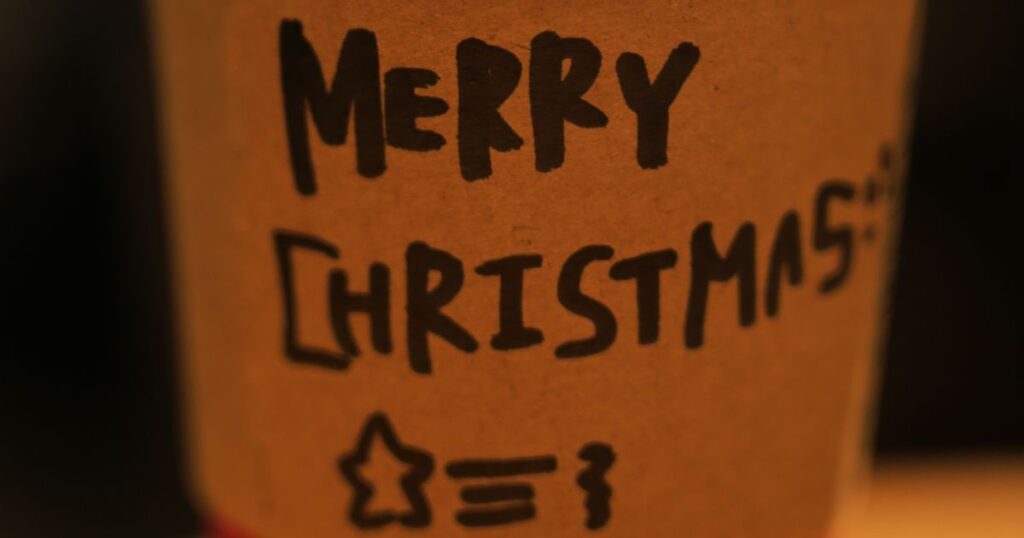
- November 2015: red cups. Starbucks replaced its decorated holiday cup with a plain two-tone red one. A viral video from evangelist Joshua Feuerstein said the company was leaving Christmas off its cups. The protest got big enough that candidate Donald Trump told a Springfield, Illinois, crowd on Nov. 9, “Maybe we should boycott Starbucks? I don’t know.” Starbucks said the cup “mimics a blank canvas,” Vox reported.
- January 2017: the refugee pledge. After President Trump’s executive order restricting entry from seven countries, then-CEO Howard Schultz said Starbucks would hire 10,000 refugees worldwide over five years. Critics launched #BoycottStarbucks, arguing the jobs should go to Americans and U.S. veterans, CNBC reported.
- October 2020: numeric targets. Starbucks set a goal of BIPOC representation of “at least 30% at all corporate levels and at least 40% at all retail and manufacturing roles by 2025.” It said it would link executive pay to diversity goals starting in fiscal 2021 and join the Board Diversity Action Alliance, according to HR Dive.
- January 2024: the 7.5% bonus slice. Starbucks’ 2024 proxy statement, filed with the SEC on Jan. 25, 2024, said inclusion and diversity goals “accounted for 7.5% of the overall fiscal year 2023 Annual Incentive Bonus Plan payout.” The first goal listed was “Serve as a mentor to BIPOC mentees,” with “No payout if did not participate.” A BIPOC retention-rate goal was listed too.
- January 2025: the metric disappears. The 2025 proxy, filed Jan. 24, 2025, said each top executive’s fiscal 2024 bonus “was based on two components”: financial goals (75%) and individual performance goals (25%). It listed no separate diversity metric.
- February 2025: Missouri sues. On Feb. 11, 2025, then-Missouri Attorney General Andrew Bailey filed a lawsuit alleging that Starbucks “enforces race-and-sex-based hiring practices.” On Feb. 5, 2026, U.S. District Judge John Ross dismissed the case, holding that the state lacked standing and had failed to state a claim, HR Dive reported. Missouri is appealing, Reuters reported in September.
- December 2025: Florida sues. Florida Attorney General James Uthmeier sued under the Florida Civil Rights Act of 1992. The suit alleged that Starbucks “excluded or disfavored nonminorities,” according to HR Dive, which reported that the state cited the 2020 targets and a 2024 regulatory filing on executive pay tied to mentoring BIPOC employees. The state sought penalties of $10,000 “for each instance of racial discrimination,” Bloomberg Law reported.
- Sept. 17, 2026: the Starbucks DEI settlement. Florida and Starbucks announced a negotiated resolution. The terms are below.
What the Florida Settlement Says
According to the attorney general’s Sept. 17 release, Starbucks committed to comply with the Florida Civil Rights Act, which the office says “prohibits race- and sex-based goals, quotas, and preferences in hiring, promotion, pay, executive compensation, mentorship programs, supplier selection, and board composition.” The company also agreed it “will not participate in any organizations that require increasing the racial diversity of its board of directors.”
Starbucks’ chief legal officer will file yearly certifications of compliance for four years, and the company will pay $1 million to the Florida Department of Legal Affairs to cover the state’s costs. “The agreement includes no admission of liability or wrongdoing by Starbucks,” the release says.
“Every Floridian deserves to be hired, promoted, and compensated based on merit, qualifications, and character—not race or sex. … DEI can never be an excuse to violate civil rights.”
Florida Attorney General James Uthmeier, Sept. 17, 2026 release
Starbucks’ statement came from Pilar Ramos, its executive vice president and chief legal officer: “We’re pleased to have resolved this matter without admission of wrongdoing and appreciate the constructive engagement of the Attorney General’s Office throughout this process. We will continue to focus on offering great jobs and career opportunities to our partners who wear the green apron, while making a positive impact on the communities we serve in Florida and around the world.”
Bloomberg Law, which reviewed the agreement, reported that a third-party consultant, picked by Florida from a list Starbucks supplies, will review an in-house audit, and that Starbucks gets 60 days to fix any problems found. Florida also keeps the right to sue for a breach.
One point is disputed: how far the deal reaches. A spokesperson for Uthmeier’s office told Reuters it applies nationwide. Starbucks spokesperson Betsy McManus said the agreement concerns compliance with Florida civil rights law, according to an editor’s note on a Florida Politics report.
The Union Starbucks Boycott, 2021 to 2026
The union boycott is not about diversity policy. It is a labor dispute over pay, staffing and a first contract.
- Dec. 9, 2021: Buffalo votes. The NLRB counted ballots at three Buffalo-area stores. The Elmwood Avenue store voted 19-8 for Workers United, the first company-owned U.S. Starbucks to unionize, NBC News reported.
- 2022: the first boycott ask. The union called for a boycott of Starbucks gift cards, according to Restaurant Dive.
- February to April 2024: talks begin. The company and union announced “a path forward” in February, and contract talks began in April, according to the union’s bargaining timeline and CBS News.
- June 13, 2024: a Supreme Court win for Starbucks. In Starbucks Corp. v. McKinney, the justices ruled 8-1 for the company in a case over fired pro-union workers, vacating a lower-court judgment, according to the Supreme Court docket.
- December 2024: talks collapse. CBS News reported the talks “fell apart in December.” The union says more than 5,000 baristas went on strike before Christmas, according to its bargaining timeline.
- April 2025: framework rejected. Union delegates voted down a company framework package that, according to the union, did not raise wages or benefits in the contract’s first year.
- Nov. 13, 2025: “Red Cup Rebellion.” On Red Cup Day, baristas at more than 65 stores in over 40 cities began an open-ended strike. “No contract, no coffee is more than a tagline,” said union spokesperson Michelle Eisen. Starbucks spokesperson Jaci Anderson said the company was seeing “minimal impacts,” with less than 1% of stores affected, CBS News reported.
- December 2025 to April 2026: strike fades, talks resume. The union said the strike peaked at more than 4,500 baristas at 230 stores in December. By early February it was down to about 1,000 baristas at fewer than 50 stores, and bargaining was set to restart in April, Northwest Labor Press reported.
- Aug. 25, 2026: the open-ended boycott. Starbucks Workers United asked supporters not to spend money at Starbucks until it reaches a contract. HuffPost reported it was the union’s first open-ended boycott not tied to a strike, and the AFL-CIO endorsed it. Anderson told The Seattle Times, “we’re committed to engaging in productive bargaining,” and said the company had seen no impact on its business.
Analysis: What Florida Actually Got
By the time Florida settled, much of what its lawsuit cited had already run out on paper. The 2020 representation goals carried a 2025 end date, and the 2025 proxy shows no diversity metric in the fiscal 2024 bonus. Board language changed too. The 2025 proxy listed “Gender, Ethnic, or National Diversity” as a director attribute and said directors with experience advocating for gender and racial equality “ensure that Starbucks continues to advance social justice, diversity, and inclusivity.” A Woke Broke List search of the 2026 proxy, filed Jan. 26, 2026, found neither phrase.
What the settlement adds is enforcement. A voluntary corporate pledge can be dropped at any time. This one carries four years of signed certifications, an outside review and a state that kept its right to go back to court. The board clause matters too: in 2020 Starbucks said it would join the Board Diversity Action Alliance, and it has now agreed not to join groups that require more racial diversity on its board. The release names no organization, and WBL could not confirm from public records whether Starbucks still belongs to the alliance.
It is worth being precise about what did not happen. No court has found that Starbucks broke the law. Missouri lost on standing, and Florida settled before any ruling on the merits. Starbucks denied wrongdoing, Reuters reported, and the agreement says so in plain words: no admission of liability or wrongdoing.
What It Means for the Starbucks Grade
Starbucks currently holds a D, 77 out of 100, on the Starbucks Woke Company Report and appears on the Woke Broke List boycott list. This timeline does not change that score. Any new finding goes through the review described in our methodology before a grade moves. Scores are Woke Broke List’s opinion based on the facts we disclose.
If you would rather spend your coffee money elsewhere, see our alternatives.