Coca-Cola’s new holiday ads are meant to feel like a tradition again. On Nov. 19, 2026, the company unveiled “Enjoy Joy,” a winter campaign whose films, it said, highlight “how simple moments of connection and togetherness can spark joy.” Trade coverage the same day described family and friends playing football, deep-frying a turkey, and sitting down to meals. A company spokesperson later confirmed to MediaPost’s Marketing Daily that the spots were made without generative AI, after two years of AI-made holiday ads that Marketing Dive said had “proved divisive with consumers.” A warmer commercial does not settle the Coca-Cola boycott.
That boycott, the one conservatives still talk about, did not start with this year’s holiday films. It started when the Atlanta company put itself in the middle of fights over race training, election laws, and Pride merchandising, then watched customers answer with their wallets.
Some of those choices were later walked back. Others are still easy to find. The official Coca-Cola Store still sells a Pride apparel collection. A Coca-Cola Canada page still posts numeric leadership targets by sex and race. Our Coca-Cola company report grades the company a C, 87 out of 100, based on that public record. A C grade stays off our boycott list, which is reserved for companies graded D or F. Shoppers who want to spend their money elsewhere can still start with our alternatives guides. Here is the dated history behind the Coca-Cola boycott, in the company’s words and in the coverage of the people who pushed back.
Coca-Cola Boycott History: A Dated Record
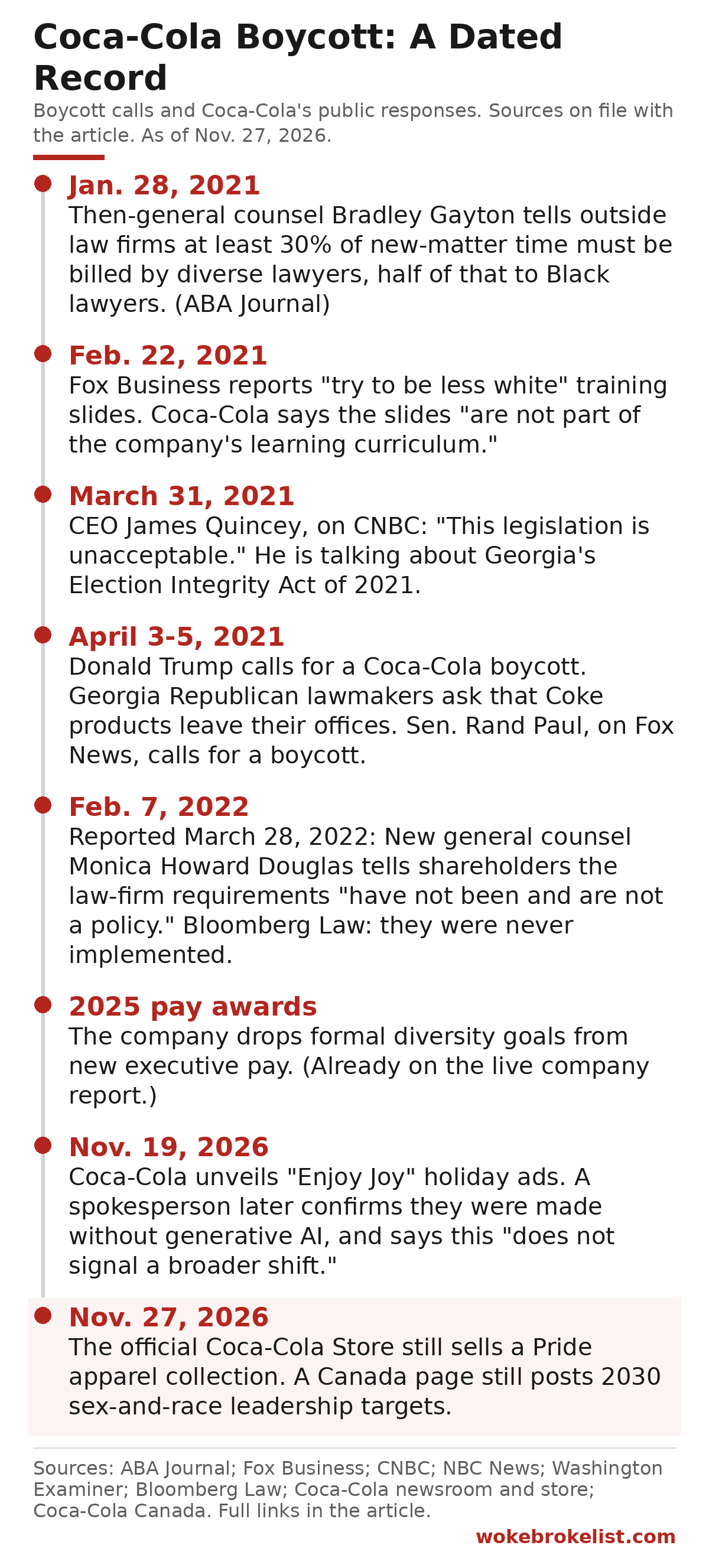
The flashpoint years are 2021 and early 2022. That is when the training screenshots spread, when Coca-Cola’s chief executive denounced Georgia’s election-integrity law on live television, and when Republican officials and a U.S. senator called for a boycott. The company’s later walk-backs, and the parts of the record it has not closed, belong in the same timeline.
The “Be Less White” Training Fight
In February 2021, screenshots circulated of a LinkedIn Learning course, “Confronting Racism,” that included a section titled “Try to be less white.” The slides, reported by Fox Business on Feb. 22, 2021, told viewers to “be less arrogant, be less certain, be less defensive, be more humble, listen, believe, break with apathy,” and to “break with white solidarity.” Another slide, as quoted by Fox Business, said white people in the United States “are socialized to feel that they are inherently superior because they are white.” It continued: “Research shows that by age 3 to 4, children understand that it is better to be white.”
Fox Business reported that the material proved divisive, with some people praising the company and others threatening a boycott. Attorney Harmeet Dhillon, who shared the slides, said they seemed “like blatant racial discrimination.”
Coca-Cola rejected the claim that this was official company training. In a letter to Fox Business, it said the slides being attributed to a Coca-Cola training program “are not part of the company’s learning curriculum.” It said its “Better Together” global training was “part of a learning plan to help build an inclusive workplace,” made up of “a number of short vignettes, each a few minutes long,” and that the training included access to LinkedIn Learning “on a variety of topics, including on diversity, equity and inclusion.”
The course was real, and the language on those slides was as ugly as it looked. The company said it had not assigned that course as its curriculum. Shoppers can read the denial and still ask why a workplace learning plan pointed employees toward that material at all.
The CEO Lectured Georgia
The larger Coca-Cola boycott came weeks later, after Georgia passed its Election Integrity Act of 2021, also known as SB 202. Left-wing activists and a group of Black executives had pressed companies to oppose the law more forcefully. On March 31, 2021, Coca-Cola Chairman and CEO James Quincey did so, live on CNBC’s “Power Lunch.”
“This legislation is unacceptable,” Quincey said, according to CNBC’s unofficial transcript of the interview. “It is a step backwards.” He went on: “This legislation is wrong and needs to be remedied and we will continue to advocate for it both in private and now even more clearly in public.”
He also said, “We’ve always opposed this legislation,” and that the company had been working with legislators “and we were doing so again this time” before the law passed. Asked whether earlier public hesitation was driven by boycotts from civil rights activists, Quincey said the company was speaking more forcefully because the legislation had passed. People, he said, “are entitled to use their wallets to express their voice.”
Conservatives did. In a statement that Saturday, April 3, 2021, former President Donald Trump called on Republicans to boycott Coca-Cola and other companies that had condemned the Georgia law, NBC News reported. “Don’t go back to their products until they relent,” the statement said.
That same weekend, eight Georgia Republican state lawmakers sent a letter to the president of the Georgia Beverage Association asking that Coca-Cola products be removed from their office suite, according to a letter obtained by the Atlanta Journal-Constitution and reported by NBC News on April 5, 2021. “Given Coke’s choice to cave to the pressure to an out-of-control cancel culture, we respectfully request all Coca-Cola Company products be removed from our office suite immediately,” the letter said.
On April 5, Sen. Rand Paul of Kentucky made the same case on Fox News. “If they want to boycott us, why don’t we boycott them?” he said, according to the Washington Examiner. “This is the only thing that will teach them a lesson. If Coca-Cola wants to only operate in Democrat states and have only Democrats drink Coca-Cola, God love ’em. We’ll see how well they do when half the country quits drinking Coca-Cola.”
The company had picked a side in a fight over how Georgia runs its elections. Customers who support election-integrity laws were told, on national television, that their state’s legislation was “unacceptable.” That is the core of the Coca-Cola boycott, and it was a choice the company made in public.
“This legislation is unacceptable.”
James Quincey, Coca-Cola chairman and CEO, on CNBC’s Power Lunch, March 31, 2021
The Law-Firm Quota That Did Not Last
The same winter, Coca-Cola’s then-general counsel, Bradley M. Gayton, tried to push the company’s diversity rules onto the law firms that worked for it. In a Jan. 28, 2021, letter, he required outside firms to commit that at least 30% of associate and partner time on new matters would be billed by diverse lawyers, and that at least half of those hours would go to Black lawyers, the ABA Journal reported that day. Firms that missed the commitment over two quarterly reviews would have their fees cut by 30% until they complied. Firms that kept missing the goals would not be considered for new work.
Gayton resigned as general counsel that April. On March 28, 2022, Bloomberg Law reported that his successor, Monica Howard Douglas, had told a group of shareholders in a Feb. 7 letter that the proposed requirements “have not been and are not a policy” at Coca-Cola. A company spokesman confirmed to Bloomberg Law that the letter was authentic. The same report said the guidelines were never implemented.
Walking back a quota that was never put into force is better than keeping it. It is not the same as staying out of the fight to begin with.
What Still Hasn’t Changed
Coca-Cola has since dropped some formal diversity goals from new executive pay, a change already recorded in our Coca-Cola company report. The new holiday ads dropped the AI look that had irritated viewers. The company’s own spokesperson told MediaPost that the choice “does not signal a broader shift,” and that AI would remain “a tool to support and enhance creative expression where appropriate.”
The record that first fed the Coca-Cola boycott is only partly closed. As of Nov. 27, 2026, the official Coca-Cola Store still offers a “Coca-Cola LGBTQ+ Pride Apparel Collection,” including Pride T-shirts and a Pride hoodie. A Coca-Cola Canada page, still live the same day, keeps this 2030 ambition on paper: “It’s our ambition by 2030 to have women hold 50% of senior leadership roles at the company, to have race and ethnicity representation reflect national census data at all levels in the U.S.”
That is why one holiday campaign cannot close the book. Families can enjoy a football-in-the-yard ad and still refuse to fund a company that sells Pride merch beside its Santa packaging and keeps sex-and-race leadership targets on its website.
The scorecard stays on the company report, which, as of this writing, grades Coca-Cola a C, 87 out of 100, with a higher score meaning better. Nothing in this article changes that grade. A C is not a boycott-list grade. That list is for companies graded D or F. Readers who want to compare other brands, or find companies that have stayed out of these fights, can use our alternatives pages.
The useful test is the one Quincey conceded on CNBC. People are entitled to use their wallets. The Coca-Cola boycott was never about a Christmas ad. It was about a company that decided political lectures were part of the brand, then asked the rest of the country to keep smiling and keep buying.