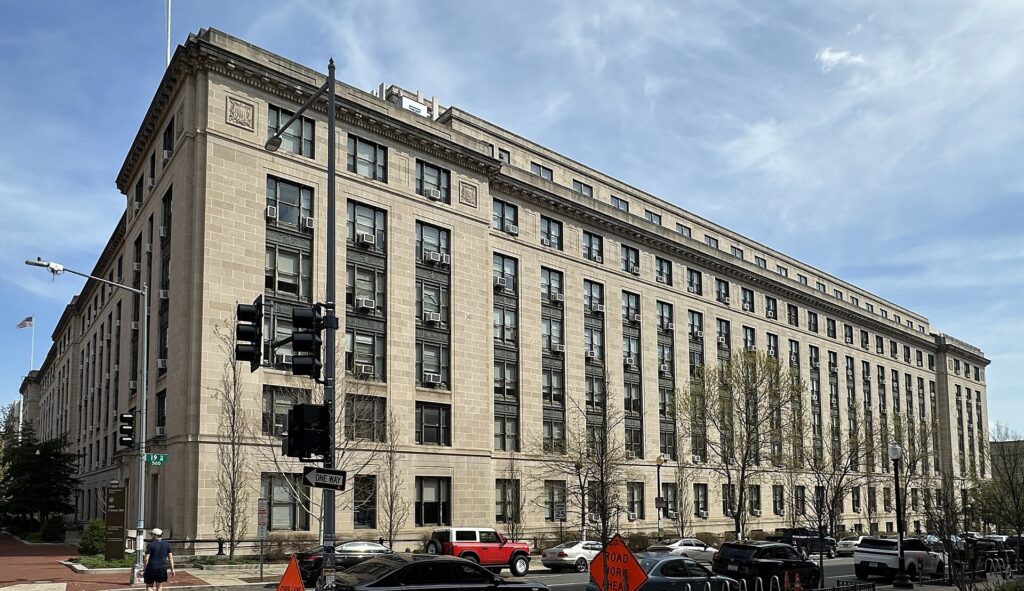
Photo: APK / Wikimedia Commons (CC BY 4.0)
General information only, not financial or legal advice. Checked October 2026.
President Donald Trump’s January 21, 2025, executive order changed how Washington treats DEI programs at federal contractors. A second order, signed March 26, 2026, added more explicit contract requirements and enforcement tools. For companies that sell to the government, DEI is no longer just a messaging question. It’s a contract promise with real liability attached.
What the First Order Changed
Executive Order 14173, titled Ending Illegal Discrimination and Restoring Merit-Based Opportunity, revoked certain earlier federal contractor affirmative-action requirements. It directed agencies to stop requiring contractors to maintain affirmative-action programs under the revoked framework and to revise federal procurement procedures.
The order also directed agencies to include contract language requiring counterparties to acknowledge that compliance with federal anti-discrimination law is material to payment decisions. It contemplated a certification that contractors do not operate programs promoting unlawful discrimination in violation of applicable federal laws.
The words unlawful discrimination matter. Federal law already prohibits certain employment decisions based on protected characteristics. A company is not automatically violating the law merely because it discusses workforce diversity or operates a generally available recruitment program.
Contractors nevertheless faced uncertainty over how procurement officials would interpret some programs. A supplier may have recruitment targets, employee-resource groups, training sessions, internship eligibility rules, scholarship partnerships or vendor-selection initiatives. Those arrangements do not all have identical legal implications.
For a purchasing officer, the practical question is whether a promised compliance certification is supported by actual company procedures. Signing without reviewing the relevant policies can carry risk beyond public criticism.
The More Specific March 2026 Order
Executive Order 14398, issued March 26, 2026, addressed what it called discriminatory diversity, equity and inclusion activity among federal contractors. It directed federal agencies to implement new contract and subcontract clauses within the timeline described by the order.
The order identifies discriminatory DEI programs in terms of different treatment based on race or ethnicity in activities such as recruiting, employment, contract awards, participation in programs and allocation of resources. It also requires covered contractors to furnish information and provide access to books, records and accounts so agencies can check compliance, and to report known subcontractor violations.
Importantly, the order made the accuracy of certification more consequential by specifying that the relevant contractual provision is material to government payment decisions under the False Claims Act. The False Claims Act is a law used to pursue certain knowingly false claims for federal funds; it does not mean every contested DEI program automatically results in a proven violation.
"The contractor recognizes that compliance with the requirements of this clause are material to the Government’s payment decisions for purposes of section 3729(b)(4) of title 31, United States Code (False Claims Act)."
Executive Order 14398, Sec. 3, March 26, 2026 (White House)
The White House order also addresses subcontractors, so compliance questions do not stop at the prime contractor’s headquarters. Companies selling into a government supply chain may need to know which clauses flow down to their own agreements.
An executive order establishes executive-branch policy. Implementation can depend on agency actions, procurement clauses, legal challenges and the particular contract. Businesses should examine actual solicitations rather than assuming every agreement already contains identical language.
How Certifications Affect Business Decisions
The federal government is a major customer for technology, construction, logistics, healthcare and professional services. Losing eligibility for a contract or facing a disputed certification can impose costs even before a case reaches a final judgment.
Consider the distinction between neutral recruiting and preferential eligibility. Advertising a position through additional community outlets to attract applicants may expand the candidate pool without restricting who can apply. Reserving a hiring opportunity exclusively for one racial group is a different policy and raises different legal issues.
Likewise, companies should distinguish voluntary employee associations from workplace opportunities restricted by protected classification. A review can examine whether participation in training, mentorship, promotion or supplier programs is open on equal terms.
None of these distinctions eliminates ordinary equal-employment obligations. Contractors still must comply with federal statutes, and the executive orders do not authorize discrimination against anyone. The relevant question is whether actual practices treat people unlawfully on protected grounds.
Changing terminology without changing eligibility rules may do little to reduce risk. A renamed program can still involve preferences if its decision rules remain the same. Conversely, eliminating a lawful program simply because its name contains DEI may go beyond what the order requires.
Why the Certification Rule Draws Pushback and Praise
Supporters of the orders argue that federal dollars should not fund hiring, advancement or supplier decisions that favor some groups over others because of race. They see certification as a way to make existing civil-rights obligations enforceable through government contracts.
Critics raise compliance questions: how lawful equal-opportunity outreach will be treated, what the extra administration will cost and how investigators will read internal practices. They argue that recruiting broadly and preventing discrimination can be compatible goals.
The government’s position is reflected in the text of the White House orders. The broader debate, however, involves both the substance of employer programs and how agencies enforce contract clauses.
Publicly traded contractors also face disclosure questions. If an enforcement dispute or loss of business becomes financially material, securities-reporting rules may require disclosure. It would be misleading to assign a dollar figure to the executive orders’ effect on a particular company without that company’s own evidence.
What Contractors Should Check
The first document to review is the applicable solicitation or executed contract. Companies should then compare actual employment and supplier policies against the specific representations requested by the agency.
Records matter: written hiring criteria, eligibility rules, compensation procedures, promotion decisions and subcontractor certifications can explain whether decisions rested on qualifications and legitimate business factors. Policies should match what employees and managers actually do.
Businesses should also separate federal requirements from rules governing state contracts, private customers and international operations. A change made to satisfy one procurement clause may not be required elsewhere.
Finally, certification language deserves legal review because it can create a factual promise to the government. An employer should be able to explain what it is certifying, which entities and subcontractors are covered and how its records support the statement. This is a compliance issue as well as a political one.
Sign Only What You Can Back Up
Federal contracting rules now focus on whether DEI-related practices involve prohibited discrimination and whether certifications are accurate. The administration says the orders enforce existing civil-rights laws through contract terms. Contractors should check their own policies before they sign, and taxpayers can judge the results.
The short version for contractors: a certification is a promise, so read it before you sign. Forward this to anyone who bids on federal work, and see the D and F companies on our Boycott List.