NPR reported on Nov. 17 that some DEI advocates hope political pressure on workplace diversity programs will ease after the midterms. Talk of companies bringing back DEI started in the same news cycle. NPR aired a clip of Rep. Ro Khanna of California saying, “Tonight, DEI is back as America celebrated diversity and inclusion.”
Hope is not a policy change. The President still holds the executive orders issued in 2025 and 2026. The EEOC is still an enforcement agency whose members the President appoints. A new Congress, once it convenes, can use oversight and the power of the purse. None of that, on its own, rewrites a company handbook. The useful question for shoppers is simpler: has any major company actually said it is reversing course?
What Changes in Washington, and What Does Not
Two January 2025 orders remain the backbone of the federal approach. Executive Order 14151, “Ending Radical and Wasteful Government DEI Programs and Preferencing,” signed Jan. 20, 2025, directed agencies to terminate DEI and DEIA programs, offices and related preferences in the federal government, to the maximum extent allowed by law. Executive Order 14173, “Ending Illegal Discrimination and Restoring Merit-Based Opportunity,” signed Jan. 21, 2025, directed agencies to end illegal preferences inside the government and to “combat illegal private-sector DEI preferences, mandates, policies, programs, and activities.” Both are still on the White House site and in the Federal Register.
The administration has not treated those orders as expired. In an Oct. 28, 2026, fact sheet, the White House said President Trump had “removed wasteful and unmeritocratic DEI programs from government, education, and the private sector” and declared, “DEI is dead.” In a statement to NPR, White House spokeswoman Allison Schuster called DEI policies “racist and destructive.” NPR reported that the White House said Trump was elected with a mandate to end these policies.
A midterm election does not take those tools away from the President. He can amend or withdraw an executive order. A court can block one. Congress can try to supersede one with a statute. Under Article I, Section 7 of the Constitution, a bill still has to pass both the House and the Senate and be presented to the President, who may sign it or return it with objections. A veto stands unless two-thirds of each chamber vote to override it. That process does not start, or end, on election night.
The calendar matters too. The 20th Amendment says the terms of Senators and Representatives end at noon on Jan. 3, and that Congress assembles then, “unless they shall by law appoint a different day.” Until that hour, the current Congress keeps its ordinary legislative authority, including spending bills. After noon on Jan. 3, 2027, the new Congress inherits the same tools: it can hold hearings, write oversight letters, and decide what to fund. Article I, Section 9 is plain on the last point: “No Money shall be drawn from the Treasury, but in Consequence of Appropriations made by Law.” Funding fights and committee scrutiny can pressure an agency. They do not, by themselves, repeal an executive order.
The EEOC sits in that same split of power. The commission’s own page, viewed Nov. 20, 2026, describes a “bipartisan Commission comprised of five presidentially appointed members, including the Chair,” and lists Andrea R. Lucas as Chair, with two other sitting commissioners and two vacant seats. A May 7, 2026, EEOC release said the agency, under Lucas, had been “implementing key deliverables entrusted to the EEOC in 11 different Executive Orders,” including cases the commission described as “DEI-related race and sex discrimination.” How we have covered that workplace guidance is here. For companies that sell to the government, a March 26, 2026, White House fact sheet said the President signed a further order requiring covered federal contracts to include a clause prohibiting “racially discriminatory DEI activities,” with cancellation, suspension or debarment as possible remedies. That contractor track is explained separately.
HR Brew, in a Nov. 6 report, quoted strategist Lily Zheng on the prospect of “increased oversight and conflict with Trump-aligned federal agencies, as well as increased direct scrutiny on corporate behavior in the form of subpoenas, hearings, and investigations.” The outlet also wrote that Zheng said the new Congress might try to “reign in the EEOC.” HR Brew, summarizing further comments from Bradley Akubuiro of Bully Pulpit International, wrote that he said the movement against DEI “won’t necessarily disappear, in part because the administration still runs much of the government, though it won’t have as much power moving forward.” Those are forecasts reported by that outlet, not a change already on the books. No prediction in this article is stated as fact.
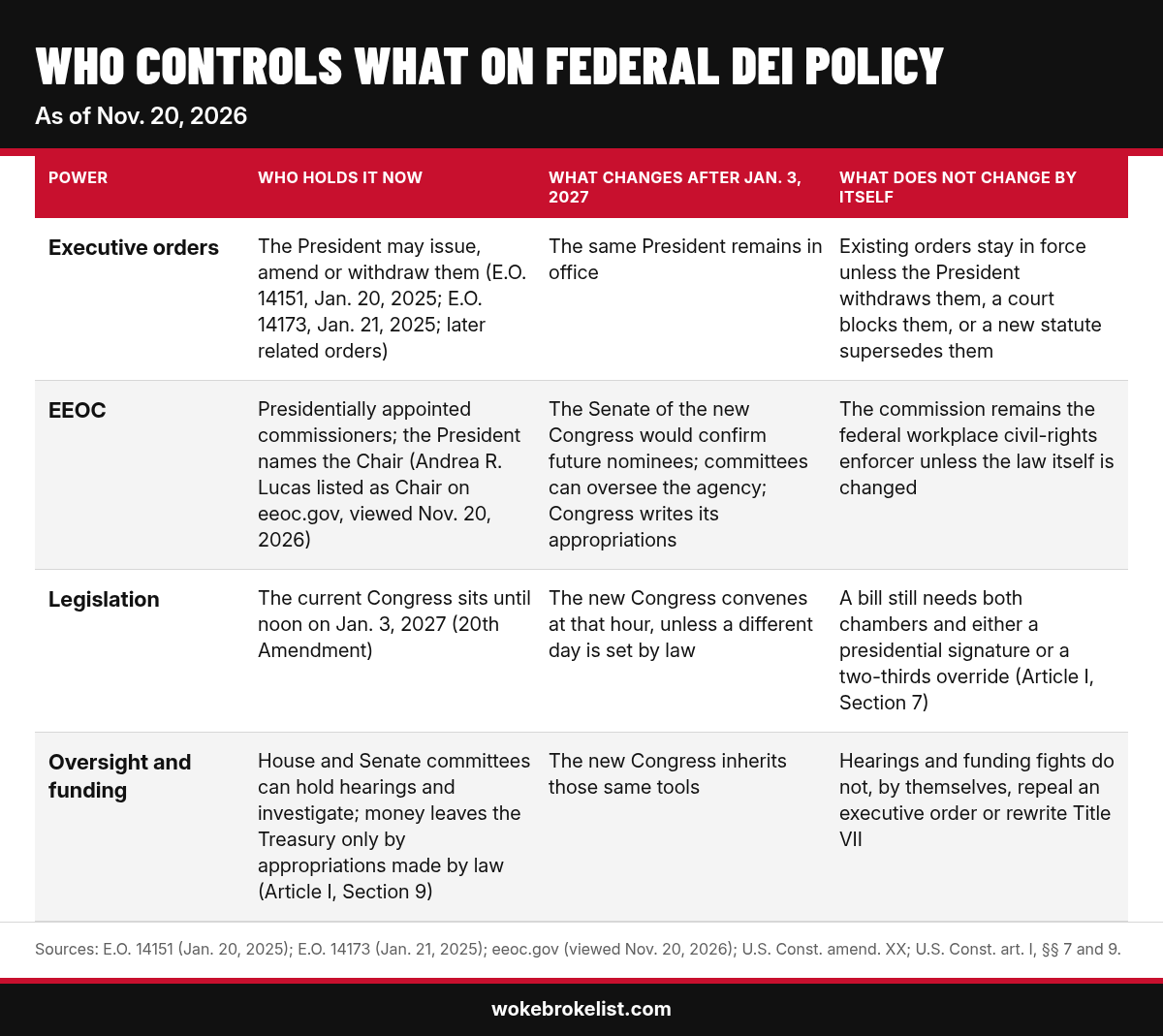
| Power | Who holds it now | What changes after Jan. 3, 2027 | What does not change by itself |
|---|---|---|---|
| Executive orders | The President may issue, amend or withdraw them (E.O. 14151, Jan. 20, 2025; E.O. 14173, Jan. 21, 2025; later related orders) | The same President remains in office | Existing orders stay in force unless the President withdraws them, a court blocks them, or a new statute supersedes them |
| EEOC | Presidentially appointed commissioners; the President names the Chair (Andrea R. Lucas listed as Chair on eeoc.gov, viewed Nov. 20, 2026) | The Senate of the new Congress would confirm future nominees; committees can oversee the agency; Congress writes its appropriations | The commission remains the federal workplace civil-rights enforcer unless the law itself is changed |
| Legislation | The current Congress sits until noon on Jan. 3, 2027 (20th Amendment) | The new Congress convenes at that hour, unless a different day is set by law | A bill still needs both chambers and either a presidential signature or a two-thirds override (Article I, Section 7) |
| Oversight and funding | House and Senate committees can hold hearings and investigate; money leaves the Treasury only by appropriations made by law (Article I, Section 9) | The new Congress inherits those same tools | Hearings and funding fights do not, by themselves, repeal an executive order or rewrite Title VII |
Are companies bringing back DEI yet?
The short answer, based on public statements reviewed for this article, is no. Not in so many words, and not since Nov. 3.
WBL already keeps a dated account of earlier corporate rollbacks at companies that cut DEI programs. This piece does not repeat that list. It asks a narrower question: which companies that already have a WBL report have said anything new about DEI since the midterms.
Target is the clearest recent case, and it is from March, not from this month. On March 11, 2026, Axios reported that leaders of a yearlong boycott over Target’s diversity pullback were ending the protest, and that “Target said no policies were reversed or reinstated as a result of conversations with its leadership.” USA Today, the same day, wrote that the boycott was “ending without any changes to the retail giant’s policy.” Ebony Porter-Ike, a spokesperson for pastor Jamal Bryant, told the paper, “There are no new commitments, no reversals.” Target’s statement to both outlets was that it was “more committed than ever to creating growth and opportunity for all,” a line that does not claim a policy reversal. USA Today also reported that another campaign, led in public by Nekima Levy Armstrong, said it would continue. Our Target report and the boycott list are the places to follow that company; nothing found since Nov. 3 adds a new Target DEI announcement.
McDonald’s did issue a public document after Nov. 3. Its Nov. 4 third-quarter earnings release discussed sales, value, loyalty and a dividend increase. It did not mention DEI, diversity, equity or inclusion. That is not a hidden restart. It is silence on the policy.
The same silence turned up for the other WBL-reported companies checked for this article, including Walmart, Amazon, Costco, Apple, Delta Air Lines, JPMorgan Chase, Johnson & Johnson, Starbucks, Disney and Netflix. No company statement, earnings release or mainstream report found since Nov. 3 announced that one of those firms was restoring a shut DEI office, bringing back a dropped representation target, or formally reversing a 2025 or early-2026 policy change. If an older position is still in place, that is a fact about last year or the year before, not a post-midterm signal. How we rate companies depends on sourced acts, not on mood.
| Company | What it has said since Nov. 3 |
|---|---|
| Target | No new DEI statement found. Last relevant public record remains the March 11, 2026, boycott-end coverage: no policy reversal, per Axios and USA Today. |
| McDonald’s | Nov. 4, 2026, third-quarter earnings release. No mention of DEI, diversity, equity or inclusion. |
| Walmart, Amazon, Costco, Apple, Delta, JPMorgan Chase, Johnson & Johnson, Starbucks, Disney, Netflix | No company statement or mainstream report found since Nov. 3 announcing a DEI restart or a new reversal. |
Social media is a poor substitute for those records. The Australian Financial Review, in a Nov. 6 dispatch filed from London, wrote about a burst of DEI-related posts and memes after the midterms. Only the opening of that article loaded without a subscription, so this piece does not rely on the rest of it. Memes are not a 10-K, a press release or a CEO letter.
Even some people who want the programs back have warned against treating a change in mood as a restart. Shaun Harper, who runs the Race and Equity Center at the University of Southern California, told NPR, “I don’t expect them to overnight flip on a switch and, you know, declare that DEI is back.” Lily Zheng, who consults with companies on workplace programs, told NPR that last year’s retreats were driven by “fear of retribution” and “fear of political and regulatory pressure,” and that some colleagues now feel relief. In comments reported by HR Brew, she also warned that executives could be tempted to restart programs for political reasons, which she said could produce “a flood of shallow commitment.” That is an advocate’s caution, and it cuts against the idea that a slogan is the same as a policy.
“I don’t expect them to overnight flip on a switch and, you know, declare that DEI is back.”
Shaun Harper, University of Southern California, to NPR, Nov. 17, 2026
If a company later announces a real change, the evidence will show up in ordinary places: a press release or 8-K, an earnings remark, a careers or supplier page, or a filing that puts a diversity office, a numeric target or a pay metric back on paper. Until then, the record since Nov. 3 is the one above. Shoppers can keep watching those primary documents. We will too. A new, sourced act can be reviewed against the scoring rules. No company grade changes on the basis of this article.